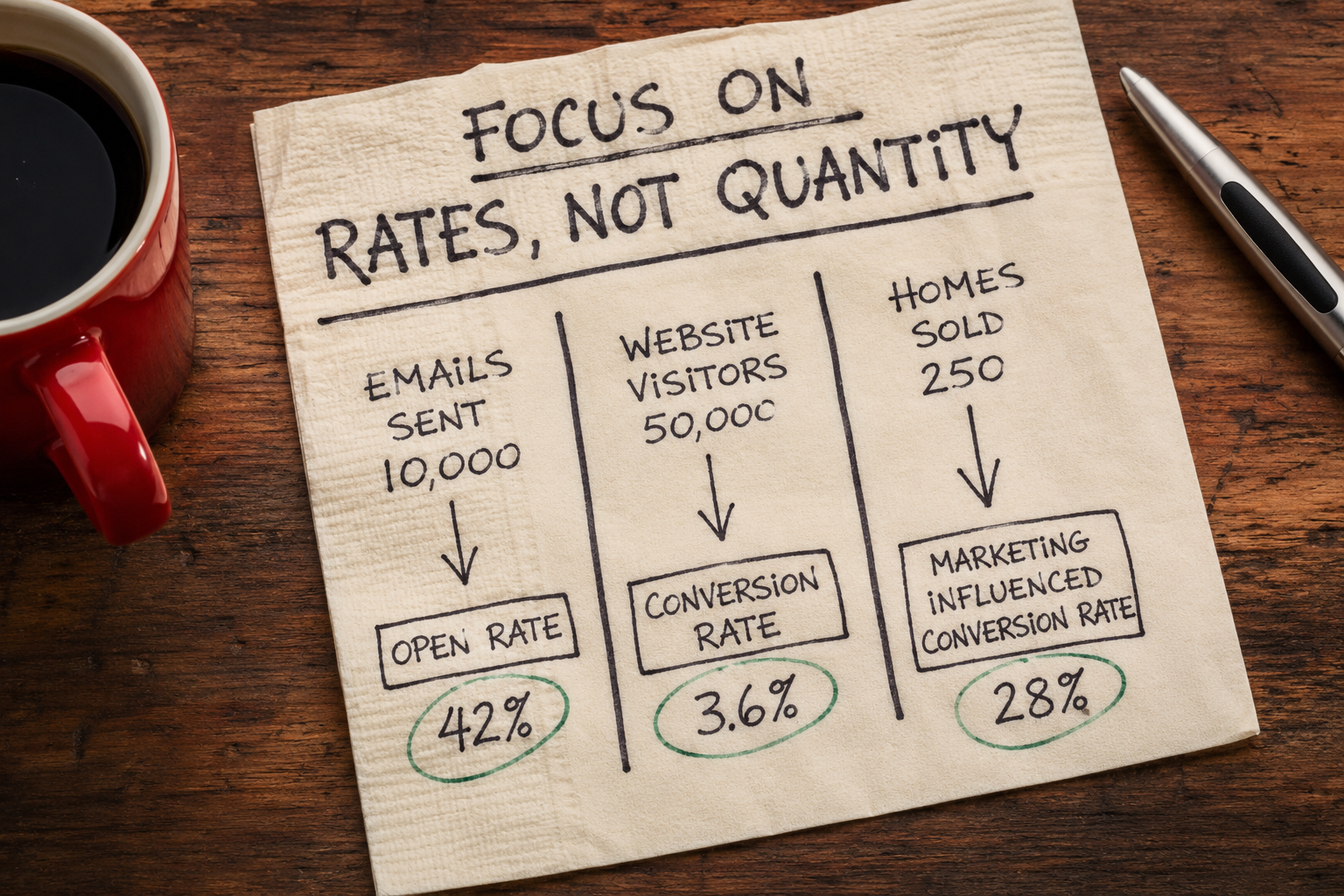
Marketing Doesn’t Need More Volume. It Needs Better Rates.
For years, marketing teams have been conditioned to chase bigger numbers.
More website traffic.
More email sends.
More impressions.
More leads.
More followers.
On paper, those numbers look impressive. They fill dashboards. They make reports feel productive. They give teams something to celebrate in Monday meetings.
But here’s the uncomfortable truth:
Volume without efficiency is often just expensive noise.
The best marketing teams don’t obsess over quantity. They obsess over rates.
Because rates tell the real story.
Anyone Can Buy Traffic
Not everyone can convert it.
A website with 100,000 visitors sounds exciting until you realize only 0.2% of those visitors filled out a form.
Meanwhile, another company may only generate 15,000 visitors per month — but convert 4% of them.
Who actually has the better marketing?
The answer is obvious.
Traffic is a vanity metric unless it produces action.
Your form fill conversion rate tells you:
- Whether your message resonates
- Whether your audience targeting is correct
- Whether your landing page is effective
- Whether your offer is compelling
- Whether your user experience creates trust
A million visitors means nothing if nobody takes the next step.
Sending More Emails Isn’t the Win
Getting people to care is.
Marketing teams love to brag about send volume.
“We sent 250,000 emails this month.”
Okay. But did anyone open them?
Open rates, click-through rates, and engagement rates tell you whether your audience actually values what you’re saying.
Because if your audience ignores your emails:
- Your messaging is weak
- Your segmentation is poor
- Your timing is off
- Your content lacks relevance
- Or your list quality is deteriorating
A smaller list with a 45% open rate is significantly more valuable than a bloated list with a 9% open rate.
In fact, obsessing over quantity often creates worse marketing over time.
Teams start prioritizing list growth instead of audience quality.
They focus on frequency instead of relevance.
They optimize for “sent” instead of “engaged.”
And eventually, they train their audience to tune them out.
Home Sales Are Not Automatically Marketing Success
This is one of the biggest misconceptions in real estate marketing.
A community may report 500 home sales this year.
That sounds incredible.
But how many of those sales can actually be attributed to marketing?
That’s the number that matters.
Because sales can come from:
- Existing brand equity
- Builder reputation
- Realtor relationships
- Organic demand
- Market conditions
- Relocation trends
- Existing waiting lists
- Pure geography
Marketing deserves credit only for the influence it can prove.
That’s why attribution matters.
If your marketing generated:
- 20% of total sales
- at a lower cost per sale
- with stronger buyer engagement
- and shorter conversion timelines
…that may actually outperform a competitor generating more total sales but with weaker marketing influence.
The best marketing leaders understand this distinction.
They stop asking:
“How many sales did we have?”
And start asking:
“How efficiently did marketing influence sales?”
Rates Reveal Operational Truth
Rates expose what raw numbers try to hide.
A high traffic number can hide a terrible website experience.
A large email database can hide weak engagement.
A large lead count can hide poor lead quality.
A large sales number can hide weak attribution.
Rates force accountability.
They reveal whether your strategy is actually working.
Some of the most important marketing metrics are ratios:
- Website Conversion Rate
- Cost Per Lead
- Lead-to-Appointment Rate
- Appointment-to-Sale Rate
- Email Open Rate
- Email Click Rate
- Return on Ad Spend
- Cost Per Sale
- Marketing-Attributed Revenue %
- Engagement Rate
These metrics tell you how effectively your marketing system performs — not just how loud it is.
Better Rates Usually Mean Better Strategy
When conversion rates improve, it usually means the fundamentals improved too.
Better targeting.
Better messaging.
Better creative.
Better timing.
Better audience alignment.
Better follow-up.
Better user experience.
High-performing marketing rarely happens accidentally.
It comes from understanding behavior.
Modern Marketing Is About Efficiency, Not Just Exposure
The old marketing model rewarded reach.
The new marketing model rewards efficiency.
Especially in industries like real estate, where marketing budgets are heavily scrutinized, the companies that win are not always the ones spending the most.
They’re the ones converting the best.
A developer with lower traffic but higher lead quality can outperform a competitor with double the budget.
A builder with better email engagement can generate more appointments from fewer sends.
A community with stronger attribution tracking can make smarter decisions faster.
Efficiency compounds.
And rates are how you measure it.
Final Thought
Big numbers are easy to present.
Rates are harder because they force honesty.
They show whether people care.
Whether they engage.
Whether they convert.
Whether your marketing actually works.
Because at the end of the day:
It doesn’t matter how many emails you sent.
It matters how many people opened them.
It doesn’t matter how much website traffic you drove.
It matters how many visitors converted.
It doesn’t matter how many home sales happened.
It matters how many sales your marketing actually influenced.
That’s the difference between activity and performance.
And the best marketers know the difference.